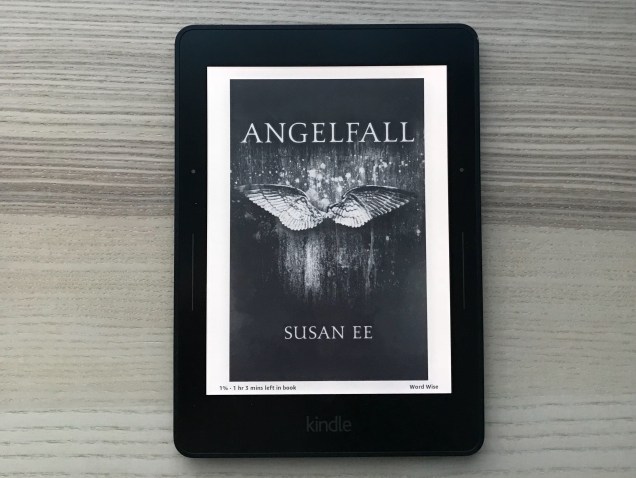
Angelfall by Susan Ee

Pages: 288
Genre: Young adult – fantasy
0BAF8DAD-23B1-40C9-8920-87A5A98C1450

Synopsis

Penryn is trying to keep her little sister and paranoid scizofrenic mother safe. It’s been six weeks since the angels took over the world and the humans around her are either in hiding or joined gangs to protect their backs. No one dares walk out at night, but Penryn has to take the chance. To hide from the angels doesn’t help if they get killed by the gangs. So she pushes her little sister’s wheelchair and try to keep an eye on her mother while walking into trouble far bigger than expected.

My thoughts

tre

It looked like a book for me from the beginning.  

I would go to the end of the world for my little brother, the same way Penryn would for her seven year old handicapped sister. Overall Penryn is a likeable character, she has flawed thinking which I’ve written more about further down, but when it boils down to it she would do anything for those she’s close to. She doesn’t especially care for the wars going on around her, nothing matters until her sister’s safe. She’s asian-american, living in the San Francisco area, a force to be reckoned with and aware of it.

The romance is much better than expected, I would even call it great. Raffe the angel is old and powerful and Penryn has conflicting emotions over him. That he has his wings cut off makes him less intimidating and dangerous, or so she believes. Raffe has a great sense of humour, he’s playing along when he wants to, but it feels like he’s lying in the middle of all the chaos having an existential crisis while Penryn is wondering what the hell she has done. I mean;

“I kick the couch for good measure. To my utter amazement, his eyes open blearily. They’re deep blue and glaring at me. ‘Can you keep it down? I’m trying to sleep.’ His voice is raw and full of pain, but somehow, he still manages to inject a certain level of condescension.”

Three things that bothered me;

  • What do you think when I say scizofrenic person? Yes, that’s the mother here; the stereotype. While reading this book, especially younger readers, it’s essential that you know not every scizofrenic person is a danger to other people, but in this book she is. The mom is capable when it comes to certain things, like her paranoid side is written to sometimes been an advantage in this dystopian world. She’s portrayed through the eyes of her daughter, who has to carry the burden, is exhausted and doesn’t seem to know all that much of scizofrenia.
  • The women at the camp of survivors/resistance are doing laundry and keeping their heads down in fear of what the big military dudes might do to them. They claim to be treated nice and no one’s ordering them around, but honestly what kind of women lives in san fransisco/silcon valley? I’m not american, but wouldn’t there be one woman capable of fighting/handling weapons/engineering before penryn comes around with her martial arts skills and short temper? The lack of other women useful to the army is the most unrealistic thing in this whole book and we’re talking about angels descending from the sky like aliens.
  • The writing varies from “oh, this is good” to “I want to sigh and/or laugh”.

It might seem so based on this review, but the “bad” things didn’t outwin the good ones in this book. I just think they’re important to point out. Overall, I enjoyed the book, but I don’t know if I’m going to read the rest of the trilogy soon.


The Secret History by Donna Tartt

Pages: 559
Genre: fiction, contemporary

IMG_20161107_154509

Lessons I learned from this book:

  • The characters are pretentious fucks and very lovable
  • Do not study greek; way too dramatic, too many dead people
  • To be like Richard – always do your homework, no matter how many life-changing secrets was revealed that week
  • The line between romanticizing and actual love is difficult. Both can kill
  • If they strike you as a cult and people talk about them as a cult, you probably should be on guard at least
  • Being the drug-selling jock is better than the rich and self-aware snob because at least you’ve learned how to run a business
  • Twins in books are always freaky, even if I love these ones dearly

Synopsis

Under the influence of their charismatic classics professor, a group of clever, eccentric misfits at an elite New England college discover a way of thinking and living that is a world away from the humdrum existence of their contemporaries. But when they go beyond the boundaries of normal morality they slip gradually from obsession to corruption and betrayal, and at last – inexorably – into evil.

My thoughts 

fem

First reaction when finishing this book was simply; no. This book was depressing and overwhelming, making me question every action the characters had taken throughout the book as well as everything else in life (wow it’s turned me dramatic), but it was fucking great. I would recommend it to everyone. Maybe not everyone, I can think of a couple persons who would look at me in horror afterwards. Don’t know what that says about me, but there’s something so special about it; even past the brilliant writing, the murder and the fabulous bonding and group dynamic.

You can read this book two ways, the way I see it. Either as the murder mystery it is, in similar fashion (although this book is older) as “How to get away with murder”, the tv series. It has elements in common when it comes to both structure, it’s a murder mystery in reverse in the sense of it starting with the murder and backtracking from there, as well as both revolves around a group of college kids. The other way too read it would be to dive into it head first AKA seeing it from the character’s perspective, interested in the big philosophy the ancient greek’s are known for for varying reasons. You quickly realize it’s not as much about who killed someone, but why. It’s certainly a question that affects everyone lives, making or breaking their destinies.

There’s lots of characters introduced throughout the book, but the story mainly revolves around the five greek students and their peculiar and charming professor Julian Morrow. He refuses to teach bigger classes, keeps the program closed off from the rest of the school and gets away with it – because that’s how good he is at the subject. No wonder there are rumors about the group, strange and nerdy as they are where they wander around together, occasionally speaking greek or other strange languages, discussing philosophy or other matters of great importance in their world. Mostly they just get drunk off their asses and travels to their mansion of a hideaway out in the country. It’s a good mix.

We hear the story from Richard Papen’s point of view as his poor, pretentious self manages to half-trick half-impress his way into this class and group. He’s the most relatable thing about the book as he struggles with loneliness and distance; it’s just the way he sees the world, constantly watching and thinking, but at least he’s found others like him. The distance he tells the story with terrifies me, even with considering if it’s something he’s picked up after the incidents that shaped his life (I think not). But certainly it makes an interesting fit when it comes to how this story is told, through the eyes of someone so in love with them all, but also more self-aware.

Beauty is terror, according to this book, but it’s also a thing of quite the obsession. At least to Richard Papen. As all of them, he’s messed up, but the aesthetic beauty he values so highly really colors the story and how the characters are perceived. Not that they’re all glorified, more described as the greek gods they study, above everyone else, but certainly with human flaws and a mundane realness as we see them study and frustrate over homework. Just look at how Richard describes his first meeting with the group that would become his friends;

“I was confused by this sudden glare of attention; it was as if the characters in a favorite painting, absorbed in their own concerns, had looked up out of the canvas and spoken to me.”

He wants to figure the world out through studying the greek philisophers as much as he wants to figure out people by studying them. Meeting people who are as guarded and secretive as himself intrigues him, being what creates this story.

I laughed out loud multiple times throughout this book, which is weird because it’s not meant to be humoring. Still, in the way it takes surreal events and makes them real and genuine, there’s something so surprising when you snap out of it and realize what just happened. What you just accepted without questioning because it sounded so natural when told by Richard Papen. What a peculiar mind these guys have, and it was lovely to live through it for a while, even if I’ll stay the hell out of ancient greek studies. I wondered how the book would end, and I still can’t really say formulate what I think about it. If you’ve read the book, please let me know your thoughts.


– favourite quotes – 

“I liked the idea of living in a city—any city, especially a strange one—liked the thought of traffic and crowds, of working in a bookstore, waiting tables in a coffee shop, who knew what kind of odd, solitary life I might slip into? Meals alone, walking the dogs in the evenings; and nobody knowing who I was.”

Forgive me, for all the things I did but mostly for the ones that I did not.”

“In short: I felt my existence was tainted, in some subtle but essential way.”

“He refused to see anything about any of us except our most engaging qualities, which he cultivated and magnified to the exclusion of all our tedious and less desirable ones.”

“I suppose at one time in my life I might have had any number of stories, but now there is no other. This is the only story I will ever be able to tell. “

Steelheart by Brandon Sanderson

Pages: 390
Genre: Young adult – fantasy

Processed with VSCO with hb2 preset

Synopsis

Ten years ago, Calamity came. It was a burst in the sky that gave ordinary men and women extraordinary powers. The awed public started calling them Epics. But Epics are no friend of man. With incredible gifts came the desire to rule. And to rule man you must crush his will.

Nobody fights the Epics…nobody but the Reckoners. A shadowy group of ordinary humans, they spend their lives studying Epics, finding their weaknesses, and then assassinating them.

And David wants in. He wants Steelheart — the Epic who is said to be invincible. The Epic who killed David’s father. For years, like the Reckoners, David’s been studying, and planning — and he has something they need. Not an object, but an experience.

He’s seen Steelheart bleed. And he wants revenge

My thoughts

tre

“The government eventually declared men such as Steelheart to be natural forces, like hurricanes or earthquakes.”

This book feels like superhero comics in novel version, but where all the villains have replaced the actual superheroes. It’s chaos, destruction and humans being undermined. But it’s also has an amazing team, fast-paced well-written action, story with quality and underground secret lair. Almost forgot; a lot of purposely bad metaphors which I found strange, but grew to like amazingly quick.

Brandon Sanderson writes with incredible speed and skill, while making complex stories. This is not an exception. It’s a young adult book in all the right ways; it’s definitely geared towards a younger audience and has lots of action, without being “dumbed-down”. The only difference I was laughing at, was him not being able to naturally put theology in there, but I spoke too soon. Turns out superhero-villains appearing like from empty air and crushing all hope is the perfect time to create beliefs.

Processed with VSCO with hb2 preset

The Reckoners are a group trying to fight back. From the looks of it, they’re part of a bigger network, but claim to consist of just two groups (i don’t believe that). There’s some original types in that group and I hope I get to know them better in the next books.

I would especially recommend this book to teenage boys, it’s written as to get those action and superhero-loving guys into books. I rarely read books where the targeted group has been as clear as here. If I wasn’t more a tomboy than my brother I would recommend it to him too. I mean –  “She can shoot like a dream and she carries tiny grenades in her top, a bit of my addled mind thought. I think I might be in love.” Tell me that’s not written with the intent of marketing. Having that target-group in mind also explains the move from focus on character’s backstories to current action and problems. I’m looking forward to reading the rest of the trilogy and trying to catch up with Sanderson’s other series. If someone’s an Epic, it’s him with that writing-speed.


– favourite quotes –

“For some reason, I was realizing, when things got really, really tense I found it easier to relax.”

“Ponder. Worry. Stay up nights, frightened for the casualties of your ideology. It will do you good to realize the price of fighting.”

“He was right. I was letting myself get distracted, like a rabbit doing math problems instead of looking for foxes.” 

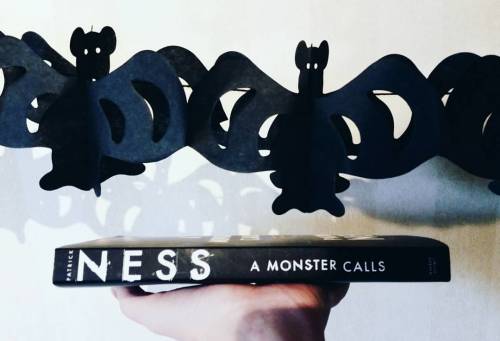
A Monster Calls by Patrick Ness 

Pages: 200

Genre: young adult, horror

9.jpg

Synopsis

The monster showed up after midnight. As they do.

But it isn’t the monster Conor’s been expecting. He’s been expecting the one from his nightmare, the one he’s had nearly every night since his mother started her treatments, the one with the darkness and the wind and the screaming…

This monster is something different, though. Something ancient, something wild. And it wants the most dangerous thing of all from Conor.

It wants the truth.

My thoughts

tre

“The monster showed up just after midnight. As they do.”

What struck me first was how well Patrick Ness had written Conor, considering he’s a child. A lot of authors seem to forget they’re people too and capable of understanding, so I was glad this wasn’t the case here. The kids are different from each other, but also have intentions behind their actions. Here a kid is even a bully with intent, not just because “he doesn’t know better”, something the teachers agree with:

A bully with charisma and top marks is still a bully.” … “He’ll probably be Prime Minister one day. God help us all.”

But this is not a story about bullying, it’s one about the harshness of reality, about feelings, grief and admitting the truth to yourself. And it’s a lot darker than it first seem, the monster is not some fluffy Pixar’s Monster Inc. version. I really liked the monster and the stories it told, it directs the whole story. The book is also about how it is for a kid to have to grow up all at once, preparing for his own meals and going to school when other things have become far more important. Some might call him “independent”, but he doesn’t admit to his situation, showing how he’s still a child acting on his fear, not sense of responsibility.

tumblr_ofiiqgEGVj1uobs14o1_5008

To be said, this is a nice story for kids to learn to deal with grief or others to remember how good it is to not be a kid anymore. Conor acts out and want someone to reprimand him so it will shake him back to the feeling of normal. The loss of control is what’s most relatable, that frustration when the world just won’t seem to listen. Still, this book isn’t ground-breaking in the way some people claim. It’s a good idea, a heartfelt story that I shed one single tear over and okay writing, but I won’t claim to understand all of the hundred quotes in different nuances the monster told about stories.

For example; “Stories are important, the monster said. They can be more important than anything. If they carry the truth.” or: “Stories are the wildest things of all, the monster rumbled. Stories chase and bite and hunt.” I have four more similar quotes, what is the difference between them? To sound mysterious? Did nothing but annoy me, unfortunately. I honestly wondered if I was rereading past pages.


– final thoughts –

It reminds me of a Neil Gaiman story, but it feels like it’s trying too hard to make everything grander or more symbolic than it’s delivered. The ending wrapped everything up with a bow so perfect that it didn’t match the tone of the rest of the story, so I don’t really know what to believe. Read it if you are curious, but if not… I don’t think you’re really missing out.

Ash by Malinda Lo

Pages: 291

Genre: fantasy – fairytales, young adult, lgbtq

Processed with VSCO with hb2 preset

Synopsis

Cinderella retold…

In the wake of her father’s death, Ash is left at the mercy of her cruel stepmother. Consumed with grief, her only joy comes by the light of the dying hearth fire, rereading the fairy tales her mother once told her. In her dreams, someday the fairies will steal her away, as they are said to do. When she meets the dark and dangerous fairy Sidhean, she believes that her wish may be granted.

The day that Ash meets Kaisa, the King’s Huntress, her heart begins to change. Instead of chasing fairies, Ash learns to hunt with Kaisa. Though their friendship is as delicate as a new bloom, it reawakens Ash’s capacity for love-and her desire to live. But Sidhean has already claimed Ash for his own, and she must make a choice between fairy tale dreams and true love.

Entrancing, empowering, and romantic, Ash is about the connection between life and love, and solitude and death, where transformation can come from even the deepest grief.

My thoughts

to

“Ash” is an okay book, with an okay main character and that’s it. Normally I like fairy tales retellings, especially if you have to guess which fairytale it is based on. In this book, however, you pretty much know straight away that it is a Cinderella story. The name of the book – and the main character – is literally Ash, as in the ash and soot Cinderella is always covered in. At the beginning, the setting sounded so promising, the fairy and fantasy-element in it so strong. Unfortunately that feeling died with her father, when she was forced away from her home and had to play it out like any other Cinderella story.

But what is a Cinderella story without a romance and a happily ever after? I was looking forward to the f/f relationship I had read all about. I am still searching for a relationship in these pages, because it never seems to start. I don’t think I can say more without spoiling the whole thing, but just know – if you want to read this book because of the lesbian/lgbtq tag/genre solely – you might want to reconsider. Unless you expect something children under twelve might call a romance, because in any relationship (friendly or romantic or sisterly), this fairytale never does anything else than skim the surface. That might be the problem for the rest of the magic elements too, we only hear about them, not actually witness them most of the time.

While this book has its magical moments, as a whole it is a bit too weak and dull. I think I’ll do as Ash and get my joy straight from the real fairytales, because this version contains too few twists or new elements to be better than the originals. Perhaps if the f/f relationship had been stronger, or maybe the plot had some original twists. But perhaps I just know too many versions of Cinderella too well, for those who only know of the Disney version, this book might be ejoyable. “Ash” had potential, but it ended there. The cover is beautiful, though.

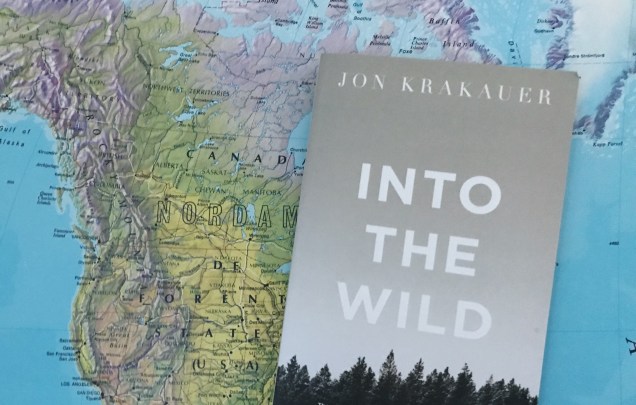
Into the Wild by Jon Krakauer

Synopsis

What does it take for a well-off young man to donate all his money and wander into the Alaskan wilderness (north of Mt. McKinley) with minimal equipment prepared? August of 1992 his body was found, four months later. After the author wrote an article on him, he chose to continue investigating what had happened and who Christopher McCandless was. It leads to this book about the events leading up to the event, how McCandless took the name Alexander Supertramp and it wasn’t his first trip alone. He had gone to Mexico and back in a kayak and wandered the US for years, meeting people who mostly got a good impression of him. It’s strange how he affected certain people, even if it’s looked at with the lense of his death becoming a nation-wide story. Alexander himself wrote about his months in the wilderness and took picture of the place, he underlined thoughtful philosophical quotes in books like anyone. But not everyone meets such an unfortunate end all alone, after having eaten something toxic or simply starving to death.

“I read somewhere… how important it is in life not necessarily to be strong, but to feel strong… to measure yourself at least once.”

My thoughts

to

I didn’t get as much out of this book as I was looking for. Mostly because it’s not Alexander/Christophers story. Obviously, since he’s ufortunately dead. His notes was the most interesting part of this book, along with the interviews of the people who met him. The author adds other similiar stories, some more interesting than others, as well as own experiences. It comes in an odd place that makes it seem more like filler than if it had been towards the end, as an extra information. There’s not enough material to justify the length of the book, which makes the middle part more boring than necessary. Other than that, the authors writing was good. There’s no romanticizing the events that occurred, but at the same time there’s given reasons for why people choose to live solitary, off the grid that way or want to be in the wilderness.

who was this person?

Personally I don’t agree with the voices claiming Christopher to have a death-wish, had overly romaticized the trip or that he’s a hero for doing something so daring and breaking out of the average life. There certainly seems to be elements of all three, he was too unprepared in the end, he seemed to be escaping and he seemed to be spontaneous. He’d already travelled a lot and been on the road, so he wasn’t straight out from normalcy and college. The last person who saw Christopher alive warned him about the dangers as he noticed he didn’t have much gear, even gave him some, but figured he wouldn’t stay out there that long. This is the part of the story where I question how in his right mind Christopher was, and what his plans were originally. But even with this there wasn’t one personality trait or fault that automatically lead to his death. He got unlucky, in the end. I think that’s the main idea I’ve gotten from this book that I wouldn’t have from articles that claim he was one thing or another. People have done stupid shit and survived, even in the wilderness of Alaska, but McCandless got unlucky.

I wonder if Christopher would’ve liked the book himself. Maybe not. I wanted to know what lead to him wanting to spend time alone out there, as well as what went wrong, and could’ve liked a more direct layout of the theories when it became obvious there were no final answer. I would recommend the book if you’re very interested, if not I think articles online or even the wiki page would be a great place to start. I haven’t yet seen the movie “into the wild”, but I’ll keep you updated when I do. I’m expecting that to give a much more “McCandless as a daring hero” vibe than this book, but maybe not.

Have you ever wanted to spend time alone in the wilderness? Can you imagine what would lead a person to do what McCandless did? I’m still wondering why he changed his name, any ideas?

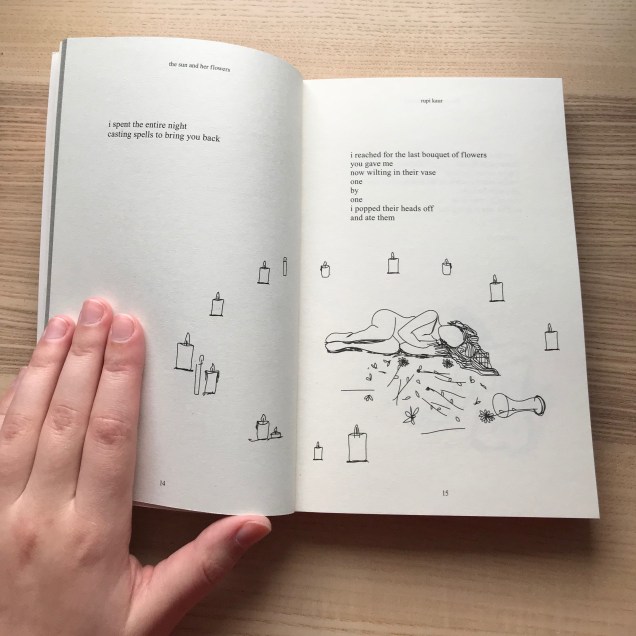
the sun and her flowers by rupi kaur

Genre: poetry

img_3709.jpg

tre

There were so many pages I liked I ripped up a napkin and used it as bookmarks and now my family is laughing at me.

I think people who really dislike this collection and the previous “milk and honey” isn’t able to look past the “it’s not poetry!?!” opinion and realize it doesn’t really matter. I think it’s gotten so popular because it’s relatable fears, opinions and thoughts from a young woman, perfectly phrased and with powerful, simple drawings. What’s so bad about that? Sometimes I like poems where you have to decipher meanings and look up words no one would use in the real world, but I get why it’s not everyone’s preferance. Let people like what they want.

In this collection, I found that I especially liked the longer writings and those about family and, well, feelings. It’s something for most in here, another reason it’s so popular. It’s not the greatest writing I’ve read, but it’s precise, clear and simple. Some lines can help as short reminders, much better than the positive quotes everywhere, while others go more in depth. Would read again. It also helps that the book looks adorable. But that doesn’t mean I necessarily got very much from it.

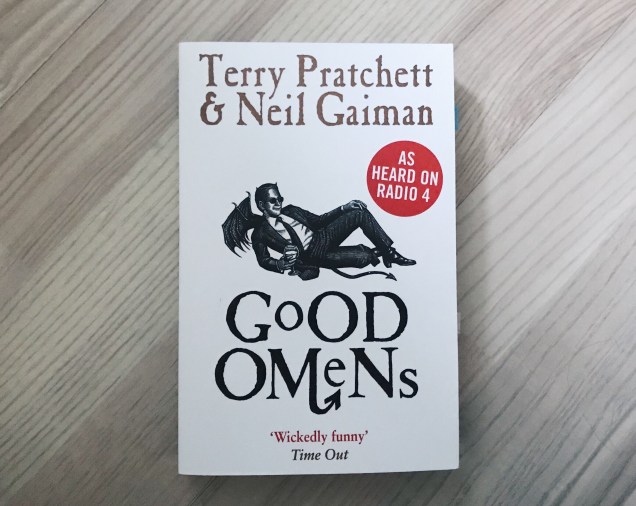
Good Omens by Terry Prachett and Neil Gaiman

The review where I find out if I liked the book or not. It felt slow and in the middle I even skimmed pages. I finished it and felt relieved, but when I think back it’s still with a certain fondness. I didn’t really enjoy the read, so what kind of witchcraft is this?

Synopsis

According to The Nice and Accurate Prophecies of Agnes Nutter, Witch (the world’s only completely accurate book of prophecies, written in 1655, before she exploded), the world will end on a Saturday. Next Saturday, in fact. Just before dinner.

So the armies of Good and Evil are gathering, Atlantis is rising, frogs are falling, tempers are flaring. Everything appears to be going according to Divine Plan. Except a somewhat fussy angel and a fast-living demon—both of whom have lived amongst Earth’s mortals since The Beginning and have grown rather fond of the lifestyle—are not actually looking forward to the coming Rapture.

And someone seems to have misplaced the Antichrist, oops

My thoughts

tre

– the unique plot – 

The gods was interesting, the end of the world is always something to read about, especially when you throw in an Antichrist, witches are a plus, but demon Crowley and angel Aziraphale is definitely the best thing about this book. They are an awesome, iconic couple and I wish we’d gotten more of them. Looking back I realize the moment they split up, and other parts of the plot unfolded, might’ve been when I lost interest.

– fantastic writing – 

I haven’t read anything by Terry Prachett, but they’re obviously both brilliant writers. The humor worked sometimes, but other times it fell through. Some elaborations to the writing made the pace even slower. Everything was leading towards the end of the world and I just wanted to get there without too many derailings. Also, it might be confusing to follow so many POV’s and some was more interesting to me than others. Ms. Zuigiber, a certain god and war journalist, is my favourite, both terrifying and impressive. Ah, I’m glad I’ve read this book, when I think of it.

– overall – 

I liked the concept, but the book itself didn’t fit me. It seems like Good Omens will become a bbc tv series and if so, I’m so excited for it. Supernatural was awesome, but dragged out and didn’t really have a point. Here you got even more potential and please make it great.  Would recommend it if you liked American Gods, have read other books by the authors before or like things like Supernatural and plots with the end of the world.

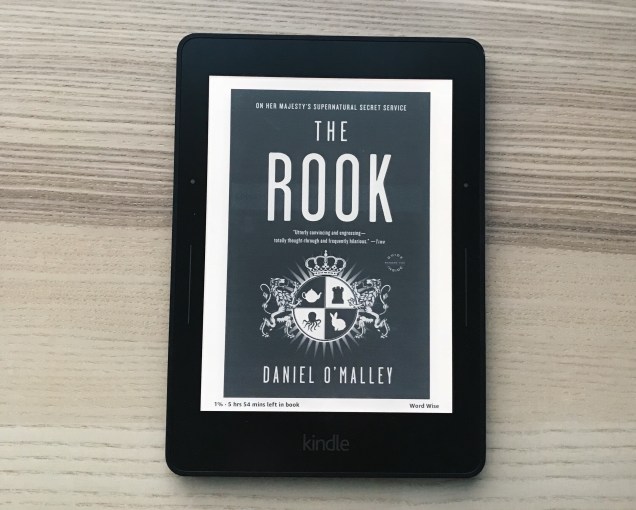
The Rook by Daniel O’Malley

Pages: 500

Genre: urban fantasy

Processed with VSCO with hb2 preset

tre

Synopsis

The Chequy is a secret organization, part of the british government and consists of people with powers. Powers like taking over other’s bodies when they touch you, like Myfawny is able to. She’s a Rook, which is a high ranking, fancy title, but mostly means she’s doing paper work and organizing. She’s considered a nervous wreck, seeing people tortured makes her throw up, but she’s really good at her desk job. She’s the “resident nerd” and a great planner, which becomes vital as she learns she will lose all memory of who she is.

My thoughts

It’s a fantastic book, and I loved all her weird colleagues like Gestalt who has multiple bodies he controls. Give me that ability please. The “secret organization” part was better than expected, since the different powers are original and interesting and so is the characters they belong to.

“You have a scary face?” Ingrid sounded skeptical. “Yes,” said Myfanwy indignantly. “I have a very scary face.” Ingrid surveyed her for a moment. “You may wish to take off the cardigan then, Rook Thomas,” she advised tactfully. “The flowers on the pockets detract somewhat from your menace.” 

When Myfawny learns she’ll wake up with no memories of who she is, she starts to write letters with information and encouragement to her new self and I loved those parts. Through that, and the words of other colleagues, you get a feeling for who she was before, and the complete personality change. The original Myfawny had been taken from her family as a child and the schooling she went through enchaced her abilities, but left her traumatized in not so obvious ways. The new version doesn’t have those memories or limits. She’s both a better and worse version because of it.

 – in short – 

Intricate and interesting mystery, witty writing that made me laugh several times. Some background info I didn’t care about, but it didn’t matter anywyay. Cool position titles. Would absoloutly read again, and recommend it for a witty and clever read.


What I Talk About When I Talk About Running by Haruki Murakami

11.jpg

That is the longest title i’ve seen in a while and it fits exceptionally well.

This book’s a part journal, part running diary of the famous author Haruki Murakami, and was the first novel I read by him. I still found this book interesting, even if I’m not a runner – not at all.

My thoughts

fire

– this book is about running and so much more – 

I was looking for motivation and insight, which I got, in a way. There’s a lot of reasons to read this book. The writing’s fantastic and so is the self-reflections and general thoughts it included. I like Murakami’s view of the world, which is a weird thing to say, but his thoughts on why he’s running and his stories are interesting in themselves. Like when he sold his jazz club to become a full-time author because it was what he wanted. He went against common sense, but he gives his reasons to why that didn’t stop him. And there seems like nothing will stop him from running for a while either, which still baffles me that one could genuinely enjoy.

– i will never run a marathon but – 

What surprised me the most was the meditation aspect of long-distance running and why someone deliberately cause themselves pain, like Murakami running a marathon in the scolding heat of greece’s summer, on his own. I’m no stranger to pain, but that’s something else. And Murakami doesn’t seem to understand it completely either, only that he wasn’t about to do it again.

When Murakami wrote this book, in 2005, he’d run somewhere around 24 marathons, which I have to be amazed at. He’s been running longer than I’ve been alive. It was really interesting to search for the reason to why he’s be able to keep putting effort into something so demanding for so long. Definitely something to strive for, but it doesn’t mean I’m about to go running anytime soon. I now believe some enjoy it, but they can keep it. I find my meditational exercise elsewhere, even if I didn’t realize it before this book. 

10

– Murakami on writing –

“Writers who are blessed with inborn talent can freely write novels no matter what they do – or don’t do. Like water from a natural spring, the sentences just well up, and with little or no effort these writers can complete at work. Occassionally you’ll find someone like that, but, unfortunately, the category wouldn’t include me. I haven’t spotted and springs nearby. I have to pound the rock with a chisel and dig out a deep hole before I can locate the source of creativity. To write a novel I have to drive myself hard physically and use a lot of time and effort. Every time I begin a new novel, I have to dredge out another new, deep hole. But as I’ve sustained this kind of life over many years, I’ve become quite efficient, both technically and physically, at opening a hole in the hard rock and locating a new water vein.”