Platonic Love & “I Think I Am In Friend-Love With You” by Yumi Sakugawa

Before reading this book I have a confession to make.

I’ve been really missing two friends that I’m having to stop myself talking about way too much in front of my family now. I’m more attached to them than they’re to me, not that I would ever admit it to them. Only that I did to one of them, the last day before I left the city because of corona, saying that sometimes I made dinner just because he was cooking. (okay we might also be flatmates, let’s be sure no one from real life ever finds this blog, shall we?) Only one of us had been drinking and it was not me, so I wonder where that courage came from. I’ve been actually searching for what my fucking problem is. Dodie Clark (a singer/youtuber) recently made a post with a caption about how she’d been obsessed with Shannon Barry as this better version of her, before they met and actually became friends. Like a friend-crush, but also jealous of. It reminded me of my situation, but both the friends are guys, so it’s not like I’m jealous and comparing myself. Well, only a little. They’re so damn smart. Anyway, enough of my troubles and let’s read this book and hopefully get some clarity or relatability.
After reading this book.

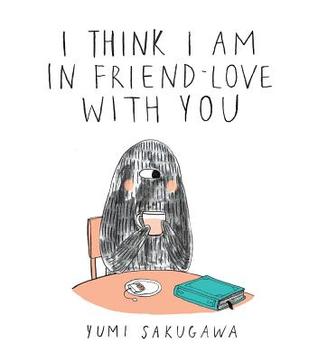
It’s like an adult kids book! This book is filled with interesting and cute, simplistic illustrations, the writing is so precise and everything just describes and/or states for future generations how friendships and friend-crushes are these days, where half or more of the relationship happens online. It also describes my situation nearly perfectly. How many times has I been so excited that the other person also struggles to fall asleep and is willing to discuss cults or strange books we read way too young.

It’s just the perfect little graphic novel. I’m shrugging in real life right now, because I don’t know what more to say. Here’s an example;
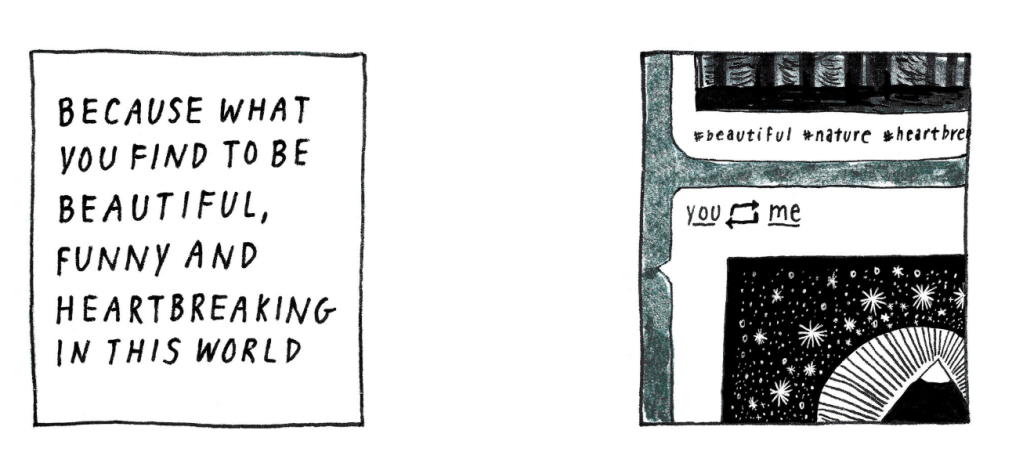
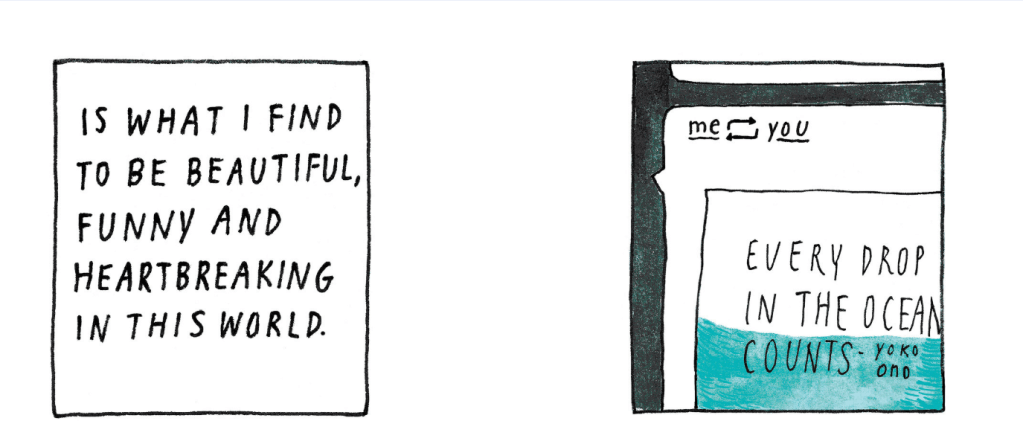
I really liked the open end, and hope from the bottom of my heart that these cuties will be best friends forever. I might also have had a online movie night with the two friends, and one of them (the one that seems most detached and independent normally) drunkenly said that this was the best moment of his week. So I’m taking that as a sign that even if we are bad at communicating all three of us, like the nerds we are, I’m not solely imagining this friendship to be bigger and stronger than it is. I might not go in for hugs anytime soon though, because last time I tried two of us was leaving for France and the last friend looked like I’d hit him, he was so confused. Totally worth being the dumb, attached one sometimes for seeing a glimse of the genuine shock on his face.

In summary, read this book if you can get your hands on it, absolutely worth it. It’s short and something I would totally buy in actual book form just to have around as a thing that warms my heart.

Also, a thing that I’ve been doing way more recently is texting friends (or telling them face to face when that was a thing) if I’m thinking about them or think they’re particularly cute that day. Like actually showing affection. I’m reserving that for everyone but these two friends though. They get scared easily, and there’s always a risk they’ll tear up if you bake cake for their birthdays. Fuck, I miss them.

Pirates & Sirens: To Kill a Kingdom by Alexandra Christo | Book Review

Genre: young adult fantasy, mermaids/sirens

Pages: 340

Synopsis

Princess Lira is siren royalty and the most lethal of them all. With the hearts of seventeen princes in her collection, she is revered across the sea. Until a twist of fate forces her to kill one of her own. To punish her daughter, the Sea Queen transforms Lira into the one thing they loathe most—a human. Robbed of her song, Lira has until the winter solstice to deliver Prince Elian’s heart to the Sea Queen or remain a human forever.

The ocean is the only place Prince Elian calls home, even though he is heir to the most powerful kingdom in the world. Hunting sirens is more than an unsavory hobby—it’s his calling. When he rescues a drowning woman in the ocean, she’s more than what she appears. She promises to help him find the key to destroying all of sirenkind for good—But can he trust her? And just how many deals will Elian have to barter to eliminate mankind’s greatest enemy? 

My thoughts

Rating out of five: three stars

I’m still not quite cold enough for the ocean that birthed me.

For a the little mermaid retelling with lots of pirates of the caribbean vibes mixed in, this was a good story. It was not as dark as it promised, however. Some parts are truly taken out of the little mermaid and the evil Ursula. I felt the story could’ve gone way deeper than it did on the abuse Lira goes through, for example it shows in a superficial, but at the same time well-placed way, why her cousin is the only siren left that Lira cares about. At the same time her beliefs, moral or confidence is never a question, the way you would’ve thought under that type of abuse. I recently read “The Midnight Lie” by Marie Rutkoski and I think that book deserved an extra star just from the mind-twisting that results from the similiar abuse the main characters had to endure there. It’s great to have a fierce female main character, who is truly deadly, but I really think a book should just go full out and not soften her, whether it’s because the plot requires it or fear of making her unlikable.

So what’s left is action and a bit of (unecessary honestly) romance, and a genuinely cool story with pirates, royals and mermaid-like sirens and horror-like mermaids. It all builds up towards this big endgame and destroying the enemy by using one item, which I was really worried about, but this standalone managed to finish it off with a good finale. Not that it wasn’t boring, but it felt epic enough. I genuinely liked the characters, and it was those who carried the story through.

Overall, I really enjoyed the book, but it’s missing a layer somehow. Both the characters, the plot and the writing is very straight-forward, which makes it an easy read, but also predictable. Definitely some enemies-to-lovers vibes going on as well, which I’ve truly realized is a trope I’m loving recently. In this book I would’ve been very happy if they’d just stayed soulmates though, and never introduced romance into it. It just didn’t really fit.

Of Poseidon by Anna Banks | Book Review

A long time ago, when this kid just had a book tumblr, a review of Of Poseidon by Anna Banks was written. I only noticed I hadn’t posted it here because I was collecting mermaid & siren books for a new post.

The Syrena Legacy #1

Pages: 320

Genre: young adult fantasy

Rating out of five: four stars

This book was an easy-read and very likable, with interesting type of sirens. Still, this book is not like I thought it would be going into it.

What this book is not: “Of Poseidon” is not a story of a stuck-up rich boy meeting the one perfect naïve girl of his dreams and showing her his world and then, SURPRISE, he is a mermaid prince (or siren, since supposedly mermaids are too normal) and they live happily ever after.

What this book actually is: A stubborn and awkward teenage boy (Galen) working as a fish-human ambassador, which leads to him seeking out an equally stubborn girl (Emma) and showing her she is neither shy, nor entirely human. Along with his sister, princess Rayna and her kind-of fiancé Toraf, they try to help Emma figure out what kind of creatures exist in this world and what she really is. This leads to Emma hitting more faces with her fists than people hitting on each other (at least at first). Is not that new and wonderful?

The characters (are wonderful)

Emma is clumsy, a book blogger, stubborn and human (she thinks). She also got a bit of a temperament, even if she thinks of herself as sweet and shy. What’s more important is how she does not tolerate bullshit, which helps in fighting Galen’s teasing and the male dominated world the sirens seems to run. She and Rayna is a kick-ass team, even if they go out of their way to annoy each other. I think that is an important note to take from this book, how they stand together when they need to. Can never have enough girl power.

“Basically, everyone thinks–knows–how sweet I am. (Emma)
Emma, you threw my sister [Rayna] through hurricane-proof glass.” 
(Galen)

The girl-power is needed because Toraf and Galen are both idiots. Funny, sympathetic idiots, but still horrible. However, that does not stop me from liking them (I think), but the idiocy is definitely something I hope they will get over when they start acknowledging how there are another world around them.

Definitely a story that will stick with me, and I am looking forward to reading the next book of the trilogy. I love reading about sea-creatures such as the syrenas, especially in summer.

The Bell Jar by Sylvia Plath | Book Review

Genre: classics, feminism

Pages: 230

Synopsis

I was supposed to be having the time of my life.

When Esther Greenwood wins an internship on a New York fashion magazine in 1953, she is elated, believing she will finally realise her dream to become a writer. But in between the cocktail parties and piles of manuscripts, Esther’s life begins to slide out of control. She finds herself spiralling into depression and eventually a suicide attempt, as she grapples with difficult relationships and a society which refuses to take women’s aspirations seriously.


The Bell Jar
, Sylvia Plath’s only novel, was originally published in 1963 under the pseudonym Victoria Lucas. The novel is partially based on Plath’s own life and has become a modern classic. The Bell Jar has been celebrated for its darkly funny and a razor sharp portrait of 1950s society and has sold millions of copies worldwide.

My thoughts

Rating out of five: four stars

I definitely get why this is a classic. I get how important it is as a semi-authobiographical story about being a woman in 1950s New York. Especially as she deals with being hospitalized for mental illness, with depression and suicidal thoughts. It’s a fantastic insight into Sylvia’s point of view. I also get why when white feminism is brought up, Sylvia Plath readers are an often used example, as there’s quite the 1950s white college woman’s racist views and not seeing longer than her own situation in here as well.

Reading it with modern eyes, I didn’t like the first half of the story. It was quite boring, seeing her trying to fit into this New York society, or how she didn’t fit in. But I realized the importance later on, it shows how her depression took hold of her. It’s a major contrast between the person she used to be, or could become, up against who she was while institutionalized. The whole book is a fascinating look into a particular situation, especially as the main character (and Sylvia) is so perceptive.

I would recommend it, but you’ve got to continue reading until the hospitalization happens to get something out of it. I’m glad I read it at this point in my life and not earlier. It required a certain patience, maybe not for the writing which flows great, but for the point of view and voice it’s written with. There’s these debates about whether to read Sylvia Plath’s work with her life in mind always or to not, but it’s not possible for me to read this without seeing it as semi-authobiographical. u also got to remember you’re reading the work of a deeply conflicted person who is going to have a more flawed perception than the average. As someone who deals with mental issues, even then I can’t understand the complete situation Sylvia Plath was in. She’s got brilliance in describing certain things and feelings, but you also got to remember you’re reading the work of a deeply conflicted person who is going to have a more flawed perception than the average. I think I disagree more about how this book is used as a classic than anything else.

Feelings while reading this book: I did cry at points. Mental health treatment was as terrifying as I expected in the 1950s. I really hated Bobby from the moment he was introduced. Worried about how relatable a Sylvia Plath novel was to me.

Favourite moment:

“I saw my life branching out before me like the green fig tree in the story. From the tip of every branch, like a fat purple fig, a wonderful future beckoned and winked. One fig was a husband and a happy home and children, and another fig was a famous poet and another fig was a brilliant professor, and another fig was Ee Gee, the amazing editor, and another fig was Europe and Africa and South America, and another fig was Constantin and Socrates and Attila and a pack of other lovers with queer names and offbeat professions, and another fig was an Olympic lady crew champion, and beyond and above these figs were many more figs I couldn’t quite make out. I saw myself sitting in the crotch of this fig tree, starving to death, just because I couldn’t make up my mind which of the figs I would choose. I wanted each and every one of them, but choosing one meant losing all the rest, and, as I sat there, unable to decide, the figs began to wrinkle and go black, and, one by one, they plopped to the ground at my feet.”

Short reviews from quarantine: young adult

I’m just going to be doing these laid back short reviews for a while I think, because I’ve got time, but not nearly enough energy hahha. Hope everyone is doing well, feel free to just chat with me in comments or on twitter regardless if we’ve talked before! I promise I won’t be quick to answer, but I would love to.

These short reviews in particular are books I read a while back, but only had collected a couple sentences about.

The Queen of Nothing (The Folk of the Air #3) by Holly Black

I truly loved The Cruel Prince. I kind of enjoyed/tolerated The Wicked King. I really didn’t care for The Queen of Nothing. My feelings reading this book; I love Jude Duarte so much, but this is just filled with expected turns and lacking plot. I really wanted to like it, but I just feel like Jude’s character is going constantly one step forward and two backwards in terms of how bold she is or how much of a villain/hero she is supposed to be. Make her darker or give her some good reasons, I don’t know. 2/5 stars.

I wasn’t planning on reading this book anytime soon, but at the beginning of the year, this book was on a free-for-all bookshelf in my hostel in Edinburgh, calling to me.

The Vanishing Stair (Truly Devious #2) by Maureen Johnson

I loved Truly Devious as well. It’s a good enough sequel, following the same type of mystery boarding-school vibe as the first one. You certainly get further in the story, especially about the old mystery at the school the main character is trying to solve. But it was also lacking the freshness and felt a bit repetitive. I’m still excited to read the third book, but a bit less hopeful I guess. 4/5 stars!

Funfact: reading the first book I definitely appreciated how all the different characters was the best at their skill. Especially Janelle’s character and how creative and stereotypical engineer-mind she had. But since then I’ve met and currently live with someone who’s the guy’s version of her and I definitely realized so while reading this. I can never say my wild plans out loud anymore, because suddenly they go from theoretical to “ahh actually, if we do it this way” … and me facepalming.

Call Down the Hawk (Dreamer #1) by Maggie Stiefvater

I was going to write a longer review, but my copy is far far away from me and then also my notes in it. Yes, I do write in my books, especially if they are pocket books.

There were lots of small things I loved in this book, but it was very much the interactions between characters I already loved from The Raven Cycle. Stiefvater has said that you could read this series as a stand-alone, but I’m not sure I agree. Call Down the Hawk didn’t feel as coherent as a book, and for me it floated on knowing the history of these characters. Like Ronan interacting with Adam’s new college friends and their too-complex card game, especially as Adam is trying to urge him to remain calm. Knowing more about how dreaming magic worked was really cool. And another upside is that I find it hard to imagine someone not falling in love with Ronan or Adam at first sight. In general I’m glad this book exist, and I’m looking forward to reading the rest of the Dreamer trilogy! 4/5 stars.

“Do you understand? For you, reality is not an external condition. For you, reality is a decision.”

Call down the hawk by Maggie Stiefvater

Bipolar books; When We Collided, An Unquiet Mind | Book Review

This is basically me doing two reviews in one, with an intro.

Do you every just realize that you don’t know enough about a group of people’s situation? That’s me after bipolar disorder is a thing that has popped up with a question mark among multiple friends more recently. It makes sense; there’s a lot that will show first signs of bipolar in their early twenties, I’ve started at university where people are under a lot of stress, people are separated from their families and more open because they need support. There’s a whole list of causes.

Read a webmd page on what bipolar is on your own, I’m not going to oversimplify it and then obviously get it wrong. I think An Unquiet Mind’s description of it and constantly using manic-depressive instead makes more sense for people unfamiliar, if not for the actual researchers.

I think I knew more about bipolar than most going into this tiny project, but that’s just because the bar is low. I love this podcast especially by sickboy, called My little blue devil and I where a girl Siobhan talks very openly and with humor about her experiences living with bipolar type 2.

As someone who has other illnesses; what I think is most important to keep in mind is that if you’re reading an account of one person’s experience, that’s that one single person. It might give you better insight into what they’re dealing with, but you can’t apply that to everyone else in that category, which makes sense logically, but people seem to completely forget it when it comes to physical and mental illnesses.

When We Collided by Emery Lord

This is a contemporary young adult with a bit of romance. It has such great characters who form a big chosen family type of bond (though many are siblings so … actual family) with their different problems. The main character Vivi is new in town & has bipolar disorder and is definitely the best written of them. It brings all the summer feelings of a romance, along with all the messiness of someone not stable, but naturally so extroverted and fierce that at the beginning it’s hard to tell for those she interacts with. I’m so mad about reviews that call her a manic pixie dream girl because 1) didn’t someone write a long article about never using that description again and we all agreed and 2) she’s literally manic and you can obviously see the switch. Is there anything I’ve learned in the past couple months it’s that a symptom of manic state is that people don’t have the same risk calculation ability.

4/5 stars. I didn’t enjoy every part as I read it, but it’s stuck in my head, especially Vivi, for a month now.

An Unquiet Mind by Kay. R. Jamison

Trigger warning for suicidal and suicide attempt.

This is a memoir from someone who knows what she’s talking about, having bipolar in her family, struggling with it through her university days, eventually researching bipolar disorder and then getting the diagnosis.

I decided early in graduate school that I needed to do something about my moods. It quickly came down to a choice between seeing a psychiatrist or buying a horse. Since almost everyone I knew was seeing a psychiatrist, and since I had an absolute belief that I should be able to handle my own problems, I naturally bought a horse.

That quote sounds about right. Reminds me a lot of;

Anyway, she eventually sells the horse and gets a psychiatrist and Lithium basically saves her life, as she describes it. Along with the amazing descriptions of living with bipolar, the part where she questions her intentions and her career really got to me. She’s got to face the concept that her disorder might make her a bad psychologist, then she goes through all the reasons why that’s wrong. And the checks she has in place if she were to go suddenly into mania (though unlikely). She instead uses that drive and passion to be a better researcher on her own disorder, which was really inspiring.

But I compare myself with my former self, not with others. Not only that, I tend to compare my current self with the best I have been, which is when I have been mildly manic. When I am my present “normal” self, I am far removed from when I have been my liveliest, most productive, most intense, most outgoing and effervescent. In short, for myself, I am a hard act to follow.

They all seemed very related to one another at the time. Not only did they seem related, but they seemed together to contain some essential key to the grandiosely tizzied view of the universe that my mind was beginning to spin.

5/5 stars. It’s beautifully written, so honest and I’m honestly impressed about the courage to publish (in 1995) for someone who is very aware about the risks of having her career as a clinical psychologist questioned afterwards.

A Woman in the Polar Night by Christiane Ritter | Book Review

A new book on the list of all-time favourites.

Genre: nonfiction, memoir, travel to the Arctic

Pages: 224

Synopsis

In 1934, the painter Christiane Ritter leaves her comfortable life in Austria and travels to the remote Arctic island of Spitsbergen, to spend a year there with her husband. She thinks it will be a relaxing trip, a chance to “read thick books in the remote quiet and, not least, sleep to my heart’s content”, but when Christiane arrives she is shocked to realize that they are to live in a tiny ramshackle hut on the shores of a lonely fjord, hundreds of miles from the nearest settlement, battling the elements every day, just to survive.

At first, Christiane is horrified by the freezing cold, the bleak landscape the lack of equipment and supplies… But as time passes, after encounters with bears and seals, long treks over the ice and months on end of perpetual night, she finds herself falling in love with the Arctic’s harsh, otherworldly beauty, gaining a great sense of inner peace and a new appreciation for the sanctity of life.

This rediscovered classic memoir tells the incredible tale of a woman defying society’s expectations to find freedom and peace in the adventure of a lifetime. 

My thoughts

Rating out of five: five stars

Reading this book was an experience, one that made me actually want to take a trip further north than Norway, to experience the Arctic for myself. Which sounds both dumb and unrealistic, but truly read this book if you want to understand why.

This book is special because of many reasons. It’s a memoir from 1934 by a german woman, the painter Christiane Ritter. Her husband has already fallen in love with the Arctic, and she decided to uproot her comfortable and rich life and see what it’s all about herself. He warns her about how isolated it really is, but it’s almost as if he’s forgotten the big change from normal city life already, becoming used to having to fend for himself, to have no one to turn to when the hut gets covered in snow, and travelling great distances to search for a better stove to cook on.

It’s obvious that it’s written in another time from Christiane Ritter’s position in life, but the emotion she conveys through very sparce wording was really breathtaking. I know enough about the cold emptiness of certain landscapes that I felt I could recognize it, and the feelings the vastness brings after you get over its overwhelming fear of isolation.

Everyone should give this book a chance, it won’t be for everyone’s taste, but it earns its place among my favourite books of all time because of its uniqueness. Why did I feel like this contains lessons in writing as well. I really wanted to add some quotes, but I left the beautiful book filled with markings at home by the university, and as its closed for now, this will have to do.

My feelings reading this book: fear on Christiane’s behalf, then impressed & mindblown. I really loved the third person with them most of the time, the Norwegian, who Christiane talks about the strange customs of. He represented my norwegian heart too well.

Circe by Madeline Miller | Book Review

Genre: Fantasy – greek mythology

Pages: 344

Synopsis

In the house of Helios, god of the sun and mightiest of the Titans, a daughter is born. But Circe has neither the look nor the voice of divinity, and is scorned and rejected by her kin. Increasingly isolated, she turns to mortals for companionship, leading her to discover a power forbidden to the gods: witchcraft.

When love drives Circe to cast a dark spell, wrathful Zeus banishes her to the remote island of Aiaia. There she learns to harness her occult craft, drawing strength from nature. But she will not always be alone; many are destined to pass through Circe’s place of exile, entwining their fates with hers. The messenger god, Hermes. The craftsman, Daedalus. A ship bearing a golden fleece. And wily Odysseus, on his epic voyage home.

There is danger for a solitary woman in this world, and Circe’s independence draws the wrath of men and gods alike. To protect what she holds dear, Circe must decide whether she belongs with the deities she is born from, or the mortals she has come to love.

My thoughts

Rating out of five: four stars

I love me some stories of greek gods & godesses, especially when they’re as flawed and vengeful as can be. And our main character Circe certainly has her flaws as well, to the point where her insecurities becomes a huge part of her choices even after hundreds of years of getting to know oneself. It started to get a bit boring halfways through. And then Circe shifts and it all gets more badass and filled with action and again grief, without sacrificing the flowing descriptive writing, focusing on details and swiftly taking you through decades. I loved how she gets these pieces of information of the “human” history happening out in the world through Hermes to her exile on the island, and also how their interactions change.

There was a line of female empowerment going through this book, a sign of greek mythology stories done well. How Circe sees what has become of her sisters, how they’ve gathered their influence and power. Not to mention her way of feeling powerful constantly shifting through the book, as the decades pass and she grows into herself.

What I reflected on most reading this book was how Circe meets this constant choice of following the rules, of staying within her boundraries, or to stand up and fight for herself and others. And it’s not one choice, but many. The clearest picture of this is how she creates this life for herself on the island and then goes back and forth about if she likes it, if she prefers this exile; sometimes lonely, sometimes with more action (through pirates and other need-a-lesson semi-exiled girls) than she would’ve liked.

My island lay around me. My herbs, my house, my animals. And so it would go, I thought, on and on, forever the same. 

It’s a more complex story than I though walking into it and certainly one I will pick up again to reread the multifaceted person Circe is throughout it.

I thought once that gods are the opposite of death, but I see now they are more dead than anything, for they are unchanging, and can hold nothing in their hands.

The Impossible Knife of Memory by Laurie Halse Anderson | Book Review

Pages: 391

Genre: young adult, mental illness – ptsd

Synopsis

For the past five years, Hayley Kincain and her father, Andy, have been on the road, never staying long in one place as he struggles to escape the demons that have tortured him since his return from Iraq. Now they are back in the town where he grew up so Hayley can attend school. Perhaps, for the first time, Hayley can have a normal life, put aside her own painful memories, even have a relationship with Finn, the hot guy who obviously likes her but is hiding secrets of his own.

Will being back home help Andy’s PTSD, or will his terrible memories drag him to the edge of hell, and drugs push him over? The Impossible Knife of Memory is Laurie Halse Anderson at her finest: compelling, surprising, and impossible to put down.

My thoughts

Rating out of five: two stars

It’s very possible to put down this book. The number of pages should be half of what it is. It had enough interesting moments for me to see if the ending would be as bad, only to find it was the worst part.

This book is aimed at middle graders, even though it’s marketed as young adult. It gives an insight to a girl – seventeen year old Hayley – dealing with her dad’s PTSD from being a war veteran. She never has a normal A4 life and only is to attend school the year before being supposed to go to college. Hayley lacks in maturity, something that gives for a very annoying inner voice narrating the story, while she’s always acting like the adult in her house and good at crises management. Like extremely good, she saves her father again and again, in gradually less realistic ways, until the book loses its suspense of belief on my part. I truly hated the wrapped-up ‘happily ever after’ ending as well, just because it didn’t match anything happening in the story and felt so very unrealistic.

There’s so many ways this book could’ve been better, because it tries to bring awareness to a very bad living situation with a girl under a lot of pressure, and a dad suffering with ptsd, not getting the help he needs. Still, I wouldn’t recommend this book, there has to be better ones out there with similiar topics.

Borderline by Mishell Baker | Review

The Arcardia Project #1 (out of three books)

Pages: 390

Genre: Urban fantasy, fae, mental health & disability, bisexual main character

Synopsis

A year ago Millie lost her legs and her filmmaking career in a failed suicide attempt. Just when she’s sure the credits have rolled on her life story, she gets a second chance with the Arcadia Project: a secret organization that polices the traffic to and from a parallel reality filled with creatures straight out of myth and fairy tales.

For her first assignment, Millie is tasked with tracking down a missing movie star, who also happens to be a nobleman of the Seelie Court. To find him, she’ll have to smooth talk Hollywood power players and uncover the surreal and sometimes terrifying truth behind the glamour of Tinseltown. But stronger forces than just her inner demons are sabotaging her progress, and if she fails to unravel the conspiracy behind the noble’s disappearance, not only will she be out on the streets, but the shattering of a centuries-old peace could spark an all-out war between worlds.

No pressure. 

My thoughts

Rating out of five: three

It’s difficult to review this book fairly, because I respect and admire the setup of it, thinking it had so much promise. Then something happened in the middle, I’m still unsure of exactly what, that made it go downhill. And the ending just highlighted those bad choices.

I’ve looked at other reviews enough to realize almost no one have the same issues with this book as me. The writing flows really good, and it made it seem to much shorter than nearly four hundred pages. I can’t say anything about the accuracy of the portrayal of the borderline main character, but I’ve seen others saying it was well done, and the author draws from own experiences. It’s obvious that the main character does certain things because of her mental illness, and the narration makes that very clear in a way I like, referring to borderline people as it happens. But then there’s enough undiscussed things that makes the character unlikable; like Millie casually thinking and saying racist things out of the blue and having a meltdown and yelling at all the people she’s come to known. It’s even mentioned by another character in the story:

“I don’t mind people being crazy,” he said. “I understand rage and depres- sion and saying stuff you regret. But when I do it, I’m just a dumb dog snap- ping his teeth. What I don’t like about you is that even when you’re being nice, even when things are good, you’re checking out people’s weaknesses, storing things up to hurt them with later. You can’t be trusted. Not ever.”

I really liked how “simple” of a urban fantasy plot this book had, because it was done so well and given new dimensions to explore with each character’s background and small elements it brought, like if they were up to do magic or not depending on how in control of their mental state they were. And I didn’t need to like Millie. But when the side characters starts to feel very one-dimensional and stereotypical – through her eyes – you kind of have lost the ability to cheer for anyone in this book, and then lost interest in how it ends. I don’t know if this is purposefully unreliable narration or not, but it doesn’t really matter because it creates the same issue. Maybe if it had happened earlier in this book, I could’ve reconnected with the characters, but I realize it’s not easy to write a book like this.

There were a lot of awesome small things as well; the bonding happening when someone found their soulmate, the setting of the magical bar. I especially love the quirky dialogue, like when a fae asks if Millie would like to come in for “sex and oranges”. How mental health and disability was such a part of the story, but at the same time not defining. Millie’s part of the story made sense, she was someone who was well-equipped and drew the story forward. Caryl, the young leader, was definitely someone who grew on you as you learned the reasons behind her behaviour, and I really felt connected to her. It just bothers me how it all falls together towards the end – I think it would’ve been better if it was just Millie being allowed to create chaos, but instead the story needs her to wrap it up and win, meaning her mental illness gets the best of her and before having any time to regroup she’s back to clean up and take on the bad guys. Which sounds awesome, but really didn’t work for this story that started out so realistic (despite the magical elements).

I will definitely read the next book. And I recommend this one; it’s worth a shot and a lot of people loved it.